Cross Reference Microsoft Word Mac
In all versions of Word, you insert a cross-reference using the Cross-reference dialog. How you get there depends on the version: In Word 2007 and above: Display the References tab of the Ribbon. In the Captions group, click on the Cross-reference button. In Word 2002 and 2003: On the Insert menu, choose Reference, then Cross-reference. Mar 19, 2020 Tech support scams are an industry-wide issue where scammers trick you into paying for unnecessary technical support services. You can help protect yourself from scammers by verifying that the contact is a Microsoft Agent or Microsoft Employee and that the phone number is an official Microsoft global customer service number. Insert the cross-reference. In the document, type the text that begins the cross-reference. For example, 'See Figure 2 for an explanation of the upward trend.' On the Insert tab, click Cross-reference. In the Reference type box, click the drop-down list to pick what you want to link to. Jul 08, 2012 I’m using MS Word 2007 in a PC (business does not give me the Mac I enjoy so much at home) and I’m cross-referencing tables and figures in my text. When I cross reference headings, footnotes, etc., it will allow me to select the Label & Number (i.e., “Figure 7”, “Table 2”) but the check box for the “include before/after” is.
- Microsoft Word Mac Torrent
- Microsoft Word Cross Reference Table
- Cross Reference Microsoft Word Mac 2017
- Microsoft Word Mac Free Download
- Cross Reference Microsoft Word Mac Free
Cross-references in longer Word 2016 documents are very handy indeed. They tell readers where to go to find more information about a topic. You can refer readers to headings, page numbers, footnotes, endnotes, and plain-old paragraphs. And as long you create captions for your cross-references with the Insert Caption button on the References tab, you can also make cross-references to equations, figures, graphs, listings, programs, and tables.
While using Word for Mac one or more Toolbars are missing and cannot be added. This behavior can be caused by one of these things: The oval button in the upper-right corner of the document was clicked. This button 'toggles' display of toolbars on and off. There is an issue with the Normal template in Word. The toolbars or menus are modified. Word for Office 365 Word 2019 Word 2016 Word 2013 More. Less Sometimes you need to manually trigger an update of the information in fields like those used in a table of contents, headers and footers, cross-references, bookmarks, and formulas in tables.
The problem with cross-references, however, is that the thing being cross-referenced really has to be there. If you tell readers to go to a heading called “The Cat’s Pajamas” on page 93, and neither the heading nor the page is really there, readers curse and tell you where to go, instead of the other way around.
Fortunately for you, Word 2016 lets you know when you make errant cross-references. If you delete the thing that a cross-reference refers to and render the cross-reference invalid, Word tells you about it the next time you update your cross-references. Best of all, if the page number, numbered item, or text that a cross-reference refers to changes, so does the cross-reference.
Follow these steps to create a cross-reference:
Write the first part of the cross-reference text.
For example, you could write To learn more about these cowboys of the pampas, see page and then type a blank space. The blank space separates the word page from the page number in the cross-reference. If you are referring to a heading, write something like For more information, see “. Don’t type a blank space this time because the cross-reference heading text will appear right after the double quotation mark.
On the References tab, click the Cross-Reference button.
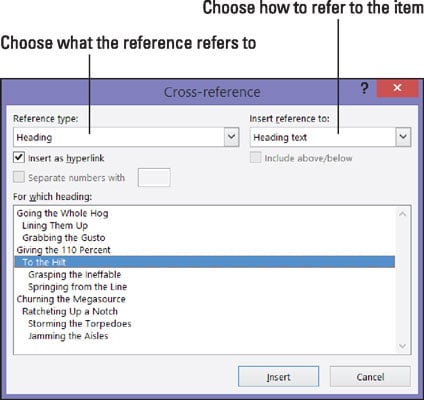
The Cross-Reference dialog box appears, as shown here.
Choose what type of item you’re referring to in the Reference Type drop-down list.
If you’re referring to a plain old paragraph, choose Bookmark. Then click outside the dialog box, scroll to the paragraph you’re referring to, and place a bookmark there. (Chapter 1 of this mini-book explains bookmarks.)
Make a choice in the Insert Reference To box to refer to text, a page number, or a numbered item.
The options in this box are different, depending on what you chose in Step 3.
Text: Choose this option (Heading Text, Entire Caption, and so on) to include text in the cross-reference. For example, choose Heading Text if your cross-reference is to a heading.
Number: Choose this option to insert a page number or other kind of number, such as a table number, in the cross-reference.
Include Above/Below: Check this box to include the word above or below to tell readers where, in relation to the cross-reference, the thing being referred to is located in your document.
If you wish, leave the check mark in the Insert as Hyperlink check box to create a hyperlink as well as a cross-reference.
With a hyperlink, someone reading the document onscreen can Ctrl+click the cross-reference and go directly to what it refers to.
In the For Which box, tell Word where the thing you’re referring to is located.
To do so, select a heading, bookmark, footnote, endnote, equation, figure, graph, or whatnot. In long documents, you almost certainly have to click the scroll bar to find the one you want.
Click the Insert button and then click the Close button.
Back in your document, enter the rest of the cross-reference text, if necessary.
When you finish creating your document, update all the cross-references. To do that, press Ctrl+A to select the entire document. Then press F9 or right-click in the document and choose Update Field on the shortcut menu.
If the thing referred to in a cross-reference is no longer in your document, you see Error! Reference source not found where the cross-reference should be. To find cross-reference errors in long documents, look for the word Error! with the Find command (press Ctrl+F). Investigate what went wrong, and repair or delete errant cross-references.
-->Note
Office 365 ProPlus is being renamed to Microsoft 365 Apps for enterprise. For more information about this change, read this blog post.
 2011-4-12 The Office for Mac 2011 14.1 Update is also available from Microsoft AutoUpdate. AutoUpdate is a program that automatically keeps Microsoft software up-to-date. To use AutoUpdate, start a Microsoft Office program. Then, on the Help menu, click Check for Updates.
Symptoms
While using Word for Mac one or more Toolbars are missing and cannot be added.
Cause
This behavior can be caused by one of these things:
- The oval button in the upper-right corner of the document was clicked. This button 'toggles' display of toolbars on and off.
- There is an issue with the Normal template in Word.
- The toolbars or menus are modified.
Resolution
To resolve this problem, try the following methods.
Method 1: Make sure that tool bar display is not turned off
In the upper-right corner of the window click the oval button.
Note
When this button is clicked, it hides all the toolbars. A second click causes the toolbars to be displayed.
If the toolbars reappear, quit, and then restart Word to make sure that the appropriate toolbars are displayed.
Microsoft Word Mac Torrent
If Method 1 did not resolve the problem, try Method 2.
Method 2: Reset the toolbars and menus in Word
You can reset the toolbars and menus in the Customize Toolbars and Menus option, any saved customization is removed, and all settings are reverted to the original default settings.
Microsoft Word Cross Reference Table
- Open Word.
- Go to View in the menu.
- Choose Toolbars.
- Select Customize Toolbars and Menus.
- Select Toolbars and Menus in the top of the Customize Toolbars and Menus window.
- Select the item in the list you want to reset (Menu Bar, Standard, Formatting).
- Click Reset.
- Click OK when getting prompt: 'Are you sure you want to reset the changes made..'
- Click OK.
Note
When View is missing from the menu, then you can also Control Click the Standard Toolbar and go to Customize Toolbars and Menus here.
If Method 2 did not resolve the problem, try Method 3.
Method 3: Create a new Normal template Note
When a new Normal template is created, any saved customization is removed, and all settings are reverted to the original default settings.
Cross Reference Microsoft Word Mac 2017
Step 1: Quit all programs
To quit active applications, follow these steps:
On the Apple menu, click Force Quit.
Select an application in the 'Force Quit Applications' window.
Click Force Quit.
Repeat the previous steps until you quit all active applications.
Warning
When an application is force quit, any unsaved changes to open documents are not saved.
When you are finished, click the red button in the upper-left corner and proceed to Step 2.
Step 2: Word 2008 and 2011: Move the Normal.dotm template file to the Trash
- Quit all Microsoft Office applications.
- On the Go menu, click Home.
- Open Library.
Note
The Library folder is hidden in MAC OS X Lion. To display this folder, hold down the OPTION key while you click the Go menu.
- Select the Application Support folder.
- Select the Microsoft folder.
- Open the Office folder.
- Open the User Templates folder.
- Move Normal.dotm to the Trash.
- Start Word, a new Normal.dotm template will be created when you choose Quit Word in the Word menu.
Microsoft Word Mac Free Download
Note
Cross Reference Microsoft Word Mac Free
When you had Word 2004 on your Mac previously and you now have Word 2008 or Word 2011, also check if the Word 2004 Normal file is present on the system, if so, trash this Normal template file as well.
Step 3: Word 2004: Move the Normal template file to the Trash
- Quit all Microsoft Office applications.
- On the Go menu, click Home.
- Select the Documents folder.
- Select the **Microsoft User Data **folder.
- Move Normal to the Trash.
- Start Word, a new Normal template will be created when you choose Quit Word in the Word menu.